
Private Carter had learned a long time ago that smoke had a sound.
It was not only the roar of timber catching fire or the pop of glass breaking under heat.
It was the terrible quiet between screams, the moment when a room filled with ash so thick that every breath felt borrowed.
That was the sound he heard again on the morning Colonel Harlan pointed him toward the gate.
There was no smoke on the parade ground that day.
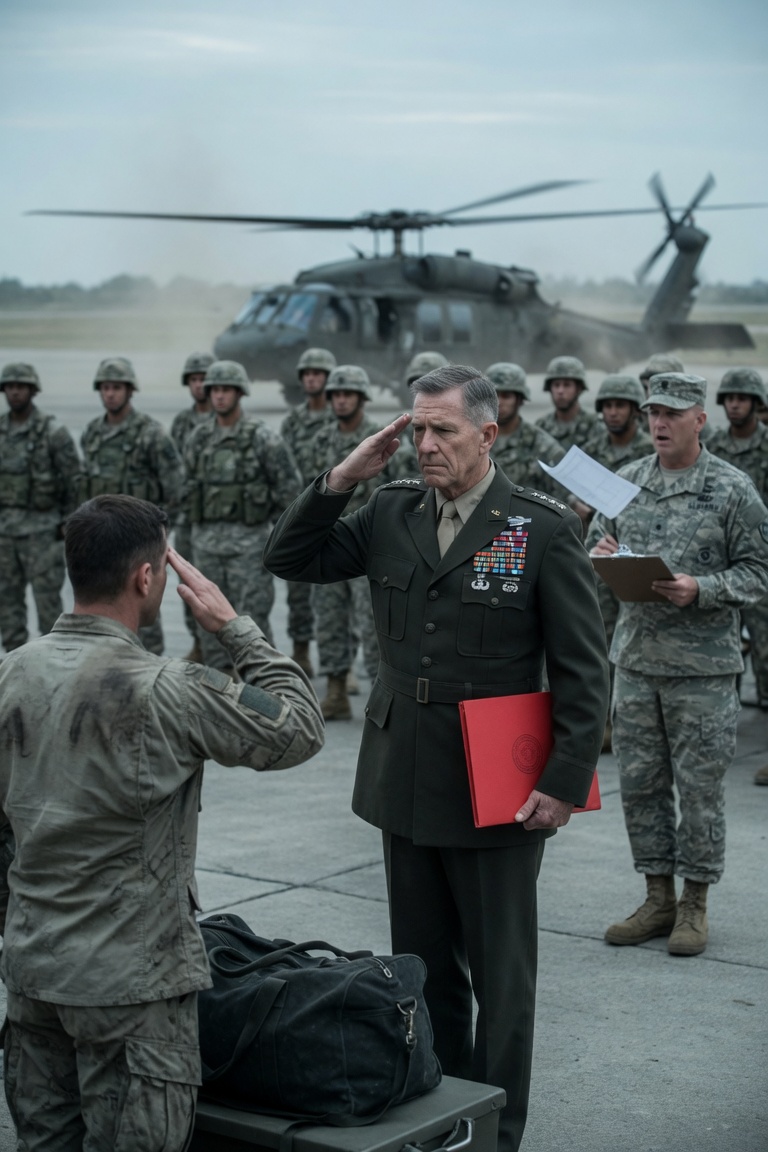
There was only cold air, gray concrete, two lines of soldiers, and one black duffel sitting against Carter’s boots.
Still, his body remembered the mountains.
It remembered the collapsed clinic wall, the soaked bandage around his left arm, the small hands reaching through broken boards, and the weight of a grown man trapped under a burning beam.
Carter had carried civilians out until his legs shook.
He had carried children first because that was what you did when adults were strong enough to wait and children were not.
He had gone back for the old woman who would not leave without her son’s photo, and he had gone back again when someone shouted that an officer was pinned near the rear hallway.
By the time he dragged that man into the road, Carter’s sleeve had already burned through.
The man in the torn officer’s coat had tried to ask his name.
Carter had only pressed a canteen into his hand and turned around because someone else was calling from inside the smoke.
That was how he remembered service.
Not as applause, not as ribbons, not as speeches, but as one more door, one more hand, one more breath held long enough to pull someone into daylight.
Five years later, the same base that had sent him into that mission stood silent while Colonel Harlan treated him like a problem to be removed.
Harlan had always disliked quiet people.
He trusted loud confidence, sharp answers, clean paperwork, and men who knew how to make themselves look useful in a briefing room.
Carter had never been good at that.
He fixed what needed fixing, took the worst watch without complaint, and stayed behind after drills if a younger soldier needed help getting something right.
He did not tell stories about the village.
He did not tell people that rain had turned the hillside into mud so deep the vehicles could not climb it.
He did not tell anyone how long he had kept pressure on his own arm before realizing the blood was his.
He did not tell the young soldiers that courage sometimes felt exactly like wanting to run and moving forward anyway.
Silence made some men suspicious.
To Harlan, it seemed to make Carter smaller.
That morning, the colonel stood ten feet away with a clipboard tucked under his arm and said Carter’s service there was finished.
Carter waited for a formal order.
He waited for a transfer number, a review, a signature, anything that would make the humiliation feel like procedure instead of punishment.
Harlan gave him nothing.
He only pointed at the front gate.
The soldiers behind him stood in formation, but Carter knew their faces.
One had eaten from the same cold ration pouch during a storm.
One had used Carter’s spare gloves during a night exercise and never returned them.
One had watched Carter haul sandbags for hours when floodwater came down from the ridge and threatened the village below.
None of them stepped forward.
Carter did not blame them, not completely.
A commander’s anger could fall on anyone standing too close.
But he felt the silence anyway.
It settled on him heavier than the duffel, heavier than the old ache in his knees, heavier than any pack he had carried up a mountain road.
Then Harlan made it personal.
“People like you confuse usefulness with importance,” he said.
Carter looked at him without blinking.
“Leave, or I will have you removed like trash.”
The sentence moved through the formation like a gust of cold wind.
A few soldiers lowered their eyes.
One young corporal swallowed hard.
Nobody said Carter’s name.
Nobody asked why.
Nobody asked what kind of man gets thrown away after giving a place his body, his holidays, his sleep, and the parts of himself that never came back from a burning village.
Carter bent down and picked up his duffel.
The buckles clicked when the strap tightened in his fist.
It sounded like small pieces of a life shutting one at a time.
He thought about answering.
For one heartbeat, he imagined saying everything he had never said.
He could have told them about the child whose shoe melted to the clinic floor.
He could have told them about the officer’s coat tearing in his hands as he dragged the trapped man free.
He could have told them about waking two days later with smoke still in his throat and refusing to ask whether anyone had written his name down.
But words spoken in your own defense can sound like begging when the room has already decided to misunderstand you.
So Carter did what he had always done.
He stayed still until the moment passed.
Then he turned toward the gate.
The first three steps felt longer than any march he had ever finished.
His boots struck the concrete with a dull, lonely sound.
Behind him, Harlan said nothing because he did not need to.
The colonel had wanted everyone to see Carter leave.
He had wanted the formation to remember who had power and who did not.
Then the ground trembled.
At first, Carter thought it was the old weakness in his knees.
He shifted the duffel higher on his shoulder and kept walking.
The tremor came again, stronger now, rolling through the concrete with a rhythm no one on a base could mistake.
Rotor blades.
A whisper moved through the soldiers.
“Is that ours?”
Carter stopped.
The ridgeline beyond the hangars cut a dark line against the pale morning sky.
Over it came a black helicopter, low and direct, flying the way aircraft fly when they are not looking for permission to be noticed.
Harlan’s clipboard lowered.
The soldiers began to break formation by inches, shoulders turning, boots sliding, discipline losing the fight against curiosity.
The helicopter did not turn toward headquarters.
It did not move toward the command office.
It came straight toward Carter and the gate.
Dust lifted from the runway before the wheels touched down.
Loose papers slapped against Harlan’s legs.
The rotor wash shoved open coats, bent collars, and flattened the loose strap on Carter’s duffel against his side.
Carter did not move.
He could not have said why.
Some part of him understood before the rest of him did that the aircraft had not arrived for the colonel.
It had not arrived for the formation.
It had come for the man Harlan had just ordered off base.
The side door opened before the blades had fully slowed.
A decorated general stepped out with a sealed red mission folder under one arm.
The general’s face was older than Carter remembered from any photograph on a wall, but his walk had the same hard purpose Carter had seen in men who made decisions under fire.
He did not look at Harlan first.
That alone changed the temperature of the parade ground.
Harlan straightened as if rank might pull the general’s attention toward him.
It did not.
The general walked through the rotor wash until he stood directly in front of Carter.
Then he raised his hand and saluted first.
Every soldier saw it.
The young corporal’s mouth fell open.
A sergeant near the rear line took one unconscious step forward.
Harlan’s expression tightened into something between confusion and fear.
Carter stared at the general’s hand and forgot, for one second, how to return the gesture.
No officer that high had ever saluted him first.
The general waited.
Only then did Carter lift his own hand.
It was not perfect.
His fingers were stiff from the grip he had kept on the duffel.
But the general held the salute until Carter completed his.
When both hands dropped, the rotor wash seemed to fade behind the silence.
“Private Carter,” the general said, “you were hard to find.”
Carter did not know what to say to that.
Harlan recovered enough to step closer.
“Sir, this soldier has been released from duty on my order.”
The general finally turned his head.
“Released,” he repeated.
“Yes, sir,” Harlan said, but the confidence had left the word.
The general held up the sealed red folder.
“Then your order is about to have a problem.”
No one moved.
The folder was thick, secured with a red band and marked for command eyes.
Carter saw dust sticking to the seal.
He saw a small dent in the edge where someone’s thumb had pressed too hard.
He saw Harlan’s face change because men who live by paperwork know when paperwork has arrived above their reach.
The general broke the seal.
The sound was small.
On that parade ground, it landed like a shot.
He opened the first sheet and read without raising his voice.
“Immediate transport authorization. Named personnel: Private Carter. Status: active, critical witness and selected field specialist.”
Harlan blinked.
“Critical witness to what, sir?”
The general looked at Carter before answering.
“To a mission you apparently never asked him about.”
Carter felt the air leave his lungs.
The general turned the top page so Harlan could see the title.
Humanitarian Extraction – Mountain Village.
The words were clean and official.
They did not smell like smoke.
They did not show the mud, the screaming, the blood under Carter’s sleeve, or the way wet ash stuck to a child’s eyelashes.
But they were real.
They existed.
Someone had written it down.
Harlan’s jaw shifted.
“Sir, with respect, that mission file was incomplete.”
“It was incomplete because the man who saved the final survivors left before anyone could identify him,” the general said.
A murmur went through the formation.
Carter’s eyes dropped to the concrete.
For years, he had told himself it did not matter.
The general removed another sheet, older and more creased than the first.
“This statement was taken after the evacuation,” he said. “The survivor was badly injured. He remembered smoke, a collapsed beam, and a soldier with a bleeding left arm who refused to give his name.”
Carter looked up.
The general held the paper differently now.
Not like an order.
Like something personal.
“I signed that statement,” he said.
The parade ground went completely still.
Harlan’s face drained.
Carter heard the helicopter ticking behind him as the rotors slowed.
The general looked at Carter with an expression that carried five years of unfinished gratitude.
“I was the man in the torn officer’s coat.”
Carter could not speak.
The memory opened so fast he felt heat on his arm again.
A hallway half gone.
A beam across a man’s legs.
The officer coughing so hard he could not answer.
Carter wrapping both hands under the man’s arms and pulling until something in his own shoulder screamed.
The road.
The canteen.
The officer trying to catch his sleeve.
Carter walking back into smoke.
“You asked my name,” Carter said finally.
“I did,” the general said.
“I did not give it.”
“No,” the general said. “You told me to keep breathing.”
The young corporal in the formation wiped at his face with the back of his hand.
A few soldiers looked away, but this time it was not indifference.
It was shame.
Harlan tried to recover the ground under him.
“Sir, Private Carter’s performance here has been inconsistent. He has shown reluctance in command settings and failed to integrate with unit expectations.”
The general looked at the two lines of soldiers.
“Did he fail to carry sandbags when the lower road flooded?”
No one answered at first.
Then the young corporal found his voice.
“No, sir.”
“Did he fail to train the younger men after hours?”
A sergeant near the back said, “No, sir.”
“Did he fail under pressure?”
The question sat in the cold air.
This time, more than one voice answered.
“No, sir.”
Harlan’s fingers tightened around the clipboard.
The general closed the folder halfway.
“Then what you call reluctance may simply be a man who does the work without performing it for you.”
That sentence did more than defend Carter.
It exposed Harlan.
Not with anger.
Not with shouting.
With the quiet precision of someone reading a measurement aloud.
Carter wanted to feel satisfaction.
Instead, he felt tired.
He had not wanted revenge.
He had wanted a reason.
He had wanted someone to see the difference between a man who made noise and a man who stayed when staying cost something.
The general stepped closer and lowered his voice, though everyone could still hear.
“Private Carter, the mission team requested you by name once we confirmed who you were.”
Carter looked toward the helicopter.
“Sir, I was told to leave.”
“You are leaving,” the general said. “Just not through that gate.”
Harlan’s head snapped up.
The general faced him fully.
“Colonel, your administrative action is suspended pending review by command. You will forward every file related to Private Carter before the end of the day.”
Harlan’s mouth opened.
The general did not let him speak.
“And you will not have him removed like trash.”
The quote came back across the parade ground with a weight that made even the wind seem to stop.
Carter saw Harlan understand that the words he had used in comfort had returned in front of the only audience that mattered.
The colonel lowered his eyes first.
That was when the formation changed.
Not officially.
No order was given.
But shoulders shifted.
Faces turned toward Carter.
The men who had looked at runway lights now looked at him.
The sergeant who had stayed silent stepped out of line and picked up Carter’s duffel from the concrete.
He held it out with both hands.
Carter looked at it for a long moment before taking it.
“Thank you,” he said.
The sergeant nodded once, unable to meet his eyes.
The young corporal spoke next.
“I’m sorry, Private.”
Carter heard the words, but he did not know where to put them.
Sorry could not undo the silence.
But it could mark the moment when silence ended.
The general turned toward the helicopter.
“We have civilians waiting on the coast after a storm surge,” he said. “Roads are gone. Local teams are overwhelmed. They need someone who knows what to do when maps stop helping.”
Carter tightened his grip on the duffel strap.
For the first time that morning, the weight felt different.
Not lighter.
Just worth carrying.
He looked once at Harlan.
The colonel stood with his clipboard against his chest, smaller somehow, surrounded by the same soldiers he had used as an audience.
Carter did not insult him.
He did not demand an apology.
He did not tell the formation what they should have done.
He only said, “Permission to board, sir?”
The general’s face softened by a fraction.
“Granted.”
Carter walked toward the helicopter.
This time, every step made a different sound.
Behind him, boots struck concrete.
At first, he thought the formation was being corrected.
Then he realized the soldiers were coming to attention.
One by one, they saluted.
The young corporal went first.
Then the sergeant.
Then the two lines that had watched him be thrown away lifted their hands because the truth had arrived in a red folder and a black helicopter, and no one could pretend not to see it anymore.
Carter reached the door and paused.
The general climbed in after him and handed over a folded copy of the survivor statement.
“I kept looking,” he said.
Carter took the paper carefully.
“Why?”
The general looked out at the parade ground, then back at him.
“Because men who save lives and disappear are usually the ones a country forgets first.”
Carter unfolded the page.
There, below the official lines, was a sentence written in a shaky hand.
The soldier with the bleeding arm went back into the fire when everyone else thought there was no one left to save.
Carter read it twice.
The helicopter lifted.
The base dropped away beneath them, shrinking into concrete, hangars, and rows of men who had finally found their courage after the hard part was over.
Carter did not wave.
He held the paper in one hand and the duffel strap in the other.
For years, he had believed that doing the right thing meant never needing anyone to know.
Maybe that was still true.
But as the helicopter turned toward the horizon, he understood something else.
A person can serve without applause, but no one deserves to be erased by people who benefited from their silence.
The general pointed toward the coast where the next mission waited.
Carter folded the statement and placed it inside his jacket.
Then he looked out at the morning sky, felt the old ache in his knees, and prepared to go where someone still needed him.
