
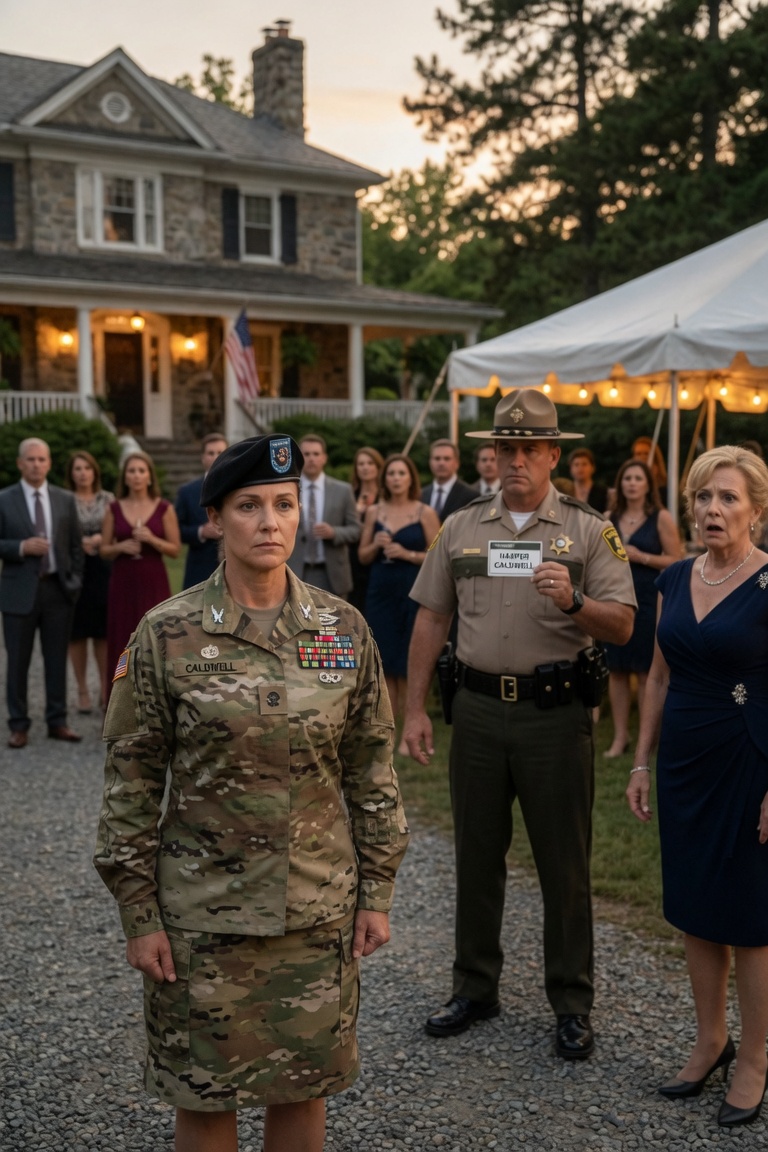
By the time Harper Caldwell reached the end of the circular driveway, the party had already turned her lake house into a stage.
The white reception tent glowed on the lawn, bright enough to reflect in the black water beyond the dock.
Music moved across the grass in neat, expensive waves.
Servers carried trays between clusters of laughing guests, and the smell of grilled food and lake air hung over the evening like nothing was wrong.
From a distance, it looked like a beautiful engagement party.
From Harper’s driver’s seat, it looked like the last favor her family would ever take from her without paying the cost.
She had not come to ruin Caroline’s night.
She had come home.
That was the part everyone on that lawn seemed prepared to forget.
The house, the dock, the porch, the lawn, the gate code, the driveway, the insurance, the maintenance, and the invoices all traced back to Harper.
Her younger sister Caroline had asked to use the place because Diane, their mother, had framed it the way she framed every request that benefited Caroline.
It was for the family.
In the Caldwell family, that phrase had never meant everyone gave equally.
It meant Harper handled the hard part, Diane took the credit, and Caroline got the photograph.
Harper had learned the pattern young.
She had been the one who could be depended on, which sounded like praise until she realized it was also a cage.
If a bill needed paying, Harper could do it.
If a holiday needed saving, Harper could rearrange her schedule.
If Caroline cried hard enough, Diane would call Harper and make the problem sound like a moral test.
This time, the test came with catering invoices, tent approvals, property access instructions, and a formal engagement party for hundreds of people.
Harper had paid the catering bill on Tuesday morning at 9:14.
She had approved the tent rental.
She had sent the gate instructions to the event company because Diane said Caroline was too overwhelmed.
She had done all of it quietly.
That was the mistake her family had confused with weakness.
When Harper stepped out of her car, conversations began to break apart.
People who had never met her turned to stare as though the real intrusion was her face.
A woman lowered a champagne flute.
Two men near the dock stopped laughing.
Someone lifted a phone before Harper had even closed her car door.
Then Diane came toward her in a navy dress, moving with the confidence of a woman who believed the crowd would protect her version of the truth.
Her smile was soft enough for strangers and sharp enough for Harper.
“You’re not supposed to be here,” Diane said.
Harper looked past her mother at the tent, the lights, the rented chairs, the servers, and Caroline standing beside Ethan with a ring flashing under the string lights.
“This is my house,” Harper said.
Caroline crossed her arms.
“I told you she’d show up,” she said.
There was no confusion in her voice.
There was only performance.
Then Caroline tilted her head and delivered the line she had apparently been waiting to use.
“Excuse me… who are you?”
Harper stared at her sister.
For one small second, she almost expected Caroline to laugh and admit it was too cruel to keep going.
Caroline did not laugh.
Diane stepped between Harper and the front walkway.
“Ma’am, you’re going to have to leave,” she said. “You weren’t invited.”
The guests went still.
That was the detail Harper would remember later more than the words.
The stillness.
Not one person asked the obvious question.
Not one person wondered why a stranger would know the driveway, the porch, the layout, the event schedule, and the names of the family members hosting the party.
They watched because watching cost them nothing.
A server stood frozen with a tray balanced on one hand.
A guest near the champagne table kept recording.
Ethan looked uncertain, but uncertainty is not the same as courage.
Harper felt anger move through her, hot and clean.
She also felt the old instinct to explain everything at once.
She could have said she owned the property.
She did say it, calmly.
“My name is Harper Caldwell,” she said. “And I own this property.”
That should have been the end of it.
It was not.
Caroline laughed.
“Don’t let her inside.”
Diane pulled out her phone and dialed 911.
The speed of it told Harper this had not happened by accident.
Diane was not reacting.
Diane was executing.
When the dispatcher answered, Diane’s voice changed into the kind of public distress people practice when they know other people are listening.
“We have a trespasser at our engagement party,” she said. “She’s refusing to leave our property.”
Our property.
That was the lie that made Harper stop feeling embarrassed.
Humiliation still hurts when it is unexpected.
When it reveals itself as strategy, something colder comes in behind it.
Harper had every document she needed.
The recorded deed was in her glove compartment.
The county clerk filing confirmation was saved in her phone.
So were the event emails, the receipts, the tent approval, the catering payment, and the access messages from Diane.
There were also gate logs, service invoices, and a security system that had seen exactly who entered the property and when.
A younger Harper might have started pulling up every file with shaking fingers.
A younger Harper might have raised her voice.
But the woman standing in the driveway had spent too many years in rooms where panic could get people hurt and discipline was not a personality trait but a requirement.
She knew the loudest person usually feared the paper trail.
So Harper waited.
At 7:46 p.m., two sheriff’s deputies drove through the open gate.
The cruiser headlights passed over the tent and made several guests step back.
The first deputy approached Harper with a careful expression.
He was not rude.
He was not warm.
He was doing what the call required him to do.
“Ma’am, may I see your identification?” he asked.
Harper handed it to him.
Before he could finish reading the name, Diane pointed at the card.
“It’s fake.”
Caroline nodded quickly beside Ethan.
“We’ve never seen this woman before.”
The deputy paused.
That pause was not proof that he believed Diane.
It was proof that Diane had created a scene complicated enough to delay the truth.
Harper understood the situation from his side.
A formal event was underway.
Hundreds of guests were present.
The caller claimed to own or control the property.
The woman accused of trespassing was calm, but calm does not automatically win against a coordinated lie.
Harper looked at the deputy and made a decision.
She would not fight her family on their chosen stage.
She would let the stage collapse under the weight of facts.
“I understand,” she said. “If my presence is making everyone uncomfortable, I’ll leave peacefully.”
The change in Diane’s face was immediate.
Relief came first.
Then triumph.
Caroline smiled as if she had finished a race she had been training for since childhood.
Ethan did not smile.
He looked from Harper to Caroline, then toward the house, as though the shape of the evening had started to bother him.
Then a low engine sound moved through the gate.
It came from the road beyond the property and traveled up the driveway before the vehicles appeared.
Several guests turned.
A few assumed it was another late arrival.
It was not.
Three olive-green Army SUVs entered the circular driveway in formation.
Their headlights swept over the white tent, the porch, the sheriff’s cruiser, the champagne table, Diane’s navy dress, and Caroline’s suddenly fixed smile.
The music faded as someone near the speaker controls finally understood the mood had changed.
The lead SUV stopped.
Uniformed soldiers stepped out first.
Their movements were quiet, precise, and completely uninterested in the party.
Then a general climbed from the front vehicle with a black folder at his side.
He did not look around for the host.
He did not ask Diane for permission.
He walked straight toward Harper.
The phones on the lawn lifted higher.
The deputy still held Harper’s ID.
The general stopped near him, looked at the card, then looked at Harper.
“Colonel,” he said.
The word was not loud.
It did not need to be.
The deputy’s posture changed.
His partner stepped closer.
Diane’s pointing hand lowered a few inches.
Caroline’s expression began to crack.
The general opened the black folder just enough for the deputy to verify the matching name and service identification.
He did not announce Harper’s work.
He did not describe her assignment.
He did not give the lawn a speech.
That restraint frightened Diane more than any dramatic statement could have.
People who are pretending usually overexplain.
People with authority do not always need to.
The deputy returned Harper’s ID with a measured nod.
Then he turned to Diane.
“Who owns the property?” he asked.
Diane opened her mouth.
For the first time that night, nothing polished came out.
Caroline tried to recover.
She said Harper was unstable.
She said Harper was jealous.
She said Harper had always created drama.
But the words no longer fit the room.
They sounded like what they were: decorations hung over a hole.
The second soldier stepped forward with printed county records pulled from the packet Harper had already provided through the proper channel.
The deed was not mysterious.
It was not emotional.
It did not care who had smiled better under the tent.
It identified Harper Caldwell as the owner.
The deputy read it once.
Then he read the filing confirmation.
Then he checked the address.
A few guests shifted backward as if the line between party and trespass had become visible on the grass.
Ethan let go of Caroline’s hand.
That small movement did more damage to Caroline than the folder.
Her face went pale.
Diane tried to step toward the deputy, but he lifted one hand, not aggressively, just enough to stop the interruption.
The situation had changed from a complaint about a trespasser to a possible false report and unlawful refusal to leave private property.
Nobody said it with drama.
That made it worse.
Procedures have a way of humiliating liars because procedures do not care how important someone felt five minutes earlier.
The deputies asked Diane to identify the person who had authorized the event.
Diane looked at Caroline.
Caroline looked at Ethan.
Ethan looked at the house.
Harper said nothing.
The event company emails answered before anyone else had to.
The access instructions came from Harper.
The payment came from Harper.
The catering invoice came from Harper.
Diane’s requests for “just one more favor” came from Diane.
The gate code request was also there.
It had Diane’s number attached to it, along with the time the code had been sent to vendors.
The deputy read enough to understand the structure.
Diane had used Harper’s permission to access the property, then tried to convert that permission into ownership once Harper arrived.
That distinction mattered.
Permission is not possession.
Kindness is not surrender.
Caroline’s guests began leaving in clusters.
No one wanted to be the last person holding champagne on a lawn that no longer belonged to the story they had been told.
The servers kept still until Harper gave them a small nod.
She did not blame them.
They had been hired, paid, and given instructions.
They were not the ones who had claimed never to know her.
The general remained beside Harper, close enough to make the room understand she was not alone, distant enough not to turn her family drama into a spectacle of rank.
The deputies separated Diane and Caroline long enough to take statements.
Ethan gave his own statement quietly.
He admitted that Caroline had told him Harper was not invited but had not told him Harper owned the house.
He admitted he had not known Harper had paid for the event.
That admission broke something visible in Caroline.
She started crying then.
Not the quiet kind.
The angry kind that looks for someone else to blame before the tears even dry.
Diane tried to comfort her, but the gesture looked different now.
Earlier, Diane had been the mother protecting the bride-to-be from an intruder.
Now she looked like a woman trying to keep a collapsing lie from spreading to the rest of her life.
Harper stood near the driveway and watched the tent empty.
The lights were still beautiful.
That was the cruel thing about money spent on a false story.
It can make the lie look warm.
The deputy returned to Harper and explained the next steps in plain terms.
The guests would be asked to leave.
The vendors could collect equipment under supervision.
Diane and Caroline would not remain on the property without Harper’s consent.
A report would document the false claim and the ownership records.
Any further issue would be handled through the proper process.
Harper listened.
She asked for the vendors to be allowed to finish safely.
She asked that nobody damage the house.
She did not ask for an arrest in front of the guests.
She did not need Caroline dragged across the lawn to feel vindicated.
The truth had already done what it came to do.
Diane heard that restraint and mistook it, again, for softness.
She approached Harper after the deputy stepped aside.
Her voice had lost the public sweetness.
“You didn’t have to embarrass your sister,” she said.
That was when Harper finally looked at her mother the way she should have looked at her years before.
She did not shout.
She did not explain her childhood.
She did not list every bill, every holiday, every time Diane had made love sound like an invoice.
She simply told Diane that the party was over.
The words landed harder because they were not decorated.
Caroline cried louder when the first vendor began folding linens.
Ethan stood apart from her, staring at the ground.
Guests who had recorded the confrontation now avoided Harper’s eyes.
That bothered her less than she expected.
People often love evidence only after it tells them they were not responsible for ignoring what was obvious.
Within an hour, the lawn looked less like a party and more like a scene being carefully dismantled.
String lights still hung overhead.
The tent still stood.
But the laughter was gone.
The champagne table had been cleared.
The dock was empty.
The little American flag on the porch moved again in the breeze, and Harper noticed it because she could finally hear the cloth snap softly in the quiet.
The general waited until the deputies finished their work.
Then he asked, in the formal tone of someone returning to the real reason he had come, whether Harper was ready.
She looked at the house first.
The house did not feel ruined.
It felt reclaimed.
That surprised her.
She had expected humiliation to stain the place.
Instead, the truth had washed something out.
Diane and Caroline were escorted off the property without speeches.
They left through the same gate they had opened for guests who were told the house was theirs.
No one clapped.
No one cheered.
Real justice is often quieter than people imagine.
Sometimes it is just a deputy closing a gate behind the right people.
Sometimes it is a vendor handing the final invoice to the person who actually signed it.
Sometimes it is a daughter deciding that family does not get unlimited access to her life because they know which wounds to press.
Harper stayed on the porch after everyone left.
The lake was dark now, and the reflection of the tent lights had vanished from the water.
Her phone buzzed several times.
Diane called once.
Caroline called twice.
Harper did not answer.
There would be time later for lawyers, boundaries, reports, and whatever version of the story her family tried to spread.
That night, she wanted silence.
She walked through the front door of her own house.
Nothing inside had changed.
The same hardwood floor.
The same framed photographs.
The same kitchen island.
The same hallway leading toward the rooms Diane had tried to keep her from entering.
Yet everything felt different because Harper had finally understood something her family should have understood first.
A house can be paid for with money.
A life is paid for with years.
And once someone spends enough years being useful to people who refuse to love her honestly, the bravest thing she can do is stop making her kindness available for theft.
By midnight, the tent crew was gone.
The driveway was empty.
The gate was closed.
Harper stood at the window with a cup of coffee she barely drank and looked out over the lawn where her mother had called her a trespasser.
She did not feel forgotten anymore.
Forgotten people do not have to leave.
They can lock the door.
