
The morning of my promotion, I kept checking my phone more than my reflection.
It was not because I was waiting for congratulations.
It was because Jacob’s voice was still trapped inside it from the night before, and some part of me needed to know the recording had not disappeared.
My dress blues were hanging where I could see them, sharp and clean, the kind of uniform that made people stand straighter even when they were alone in a room.
The brass on the jacket caught the light from the window.
The white belt lay across the chair like a line I was supposed to cross.
For most Marines, a promotion ceremony is a milestone.
For me, it felt like proof that I had survived a house that kept trying to name me before I could name myself.
I was nineteen years old, stationed near Charleston, and carrying a baby I had not announced with joy because joy had never been safe around my family.
In our house, good news had a way of becoming an accusation.
If I did well, Harold called it showing off.
If I stayed quiet, my mother called it keeping peace.
If Jacob hurt me, everyone acted like I had made it happen by standing too close to him, speaking too sharply, or breathing in the wrong direction.
That morning, as I fastened my uniform, I thought about the tiny life inside me and made myself a promise.
I would not let my child learn that silence was the rent you paid to belong to a family.
The promise sounded brave in my head.
My hands still shook when I picked up the phone.
Jacob had called late the night before, and I had answered only because ignoring him would have meant a dozen more calls and Harold pounding on my door in the morning.
He wasted no time.
He told me the uniform did not make me better than anyone.
He called my Marines my “jarhead friends” with the same sneer he used on every good thing that had not gone through him first.
Then his voice dropped into the tone he used when he wanted me to remember I was still, in his mind, the girl he could corner in a hallway.
He said he would show them what I really was.
Harold came onto the line after that.
He called my baby a problem.
He told me to cancel the ceremony.
He said I was about to embarrass the family in front of people who did not need to know our business.
I remember staring at the dark window while he spoke, watching my own reflection stand there in half uniform, half fear.
The old version of me would have apologized.
The old version of me would have promised to fix whatever feeling they had decided was my fault.
Instead, I lowered the phone, checked the red recording line, and let them keep talking.
The Marine Corps had taught me a lot of things I did not have language for before.
It taught me how to move when my body wanted to freeze.
It taught me how to listen under pressure.
Most of all, it taught me that a threat spoken out loud is no longer just a shadow in your head.
It is evidence.
By the time I walked into the auditorium, my phone had the calls saved.
I did not feel powerful.
I felt like someone carrying a glass jar through a crowded room.
My mother was already sitting in the front row beside Harold when I entered.
She looked neat, controlled, and tired in the way she always did when she had chosen not to see something.
Harold sat with his arms crossed and his chin raised, staring at the stage as if it had personally inconvenienced him.
I looked for one small sign from my mother.
A nod.
A smile.
A blink that said she knew this mattered to me.
She gave me nothing.
Still, I stood where I was told to stand.
That is what training does.
It gives your body instructions when your heart is trying to run.
My commanding officer waited with the chevrons.
The room settled into the hush that comes before a formal moment, the kind of silence where every cough sounds rude and every chair leg feels too loud.
The stage smelled of polish and dust warmed by lights.
My gloves felt snug.
The baby shifted, or maybe I imagined it because I needed to believe I was not standing there alone.
The ceremony began.
Names were spoken.
Boots moved in clean lines.
Families leaned forward with phones and small proud smiles.
For a few minutes, I allowed myself to think maybe Jacob had only wanted to scare me.
That was another habit from my old life.
I kept confusing delayed cruelty with mercy.
Then the side door opened.
The sound was not loud, but it cut through the ceremony because nobody was supposed to come in that way.
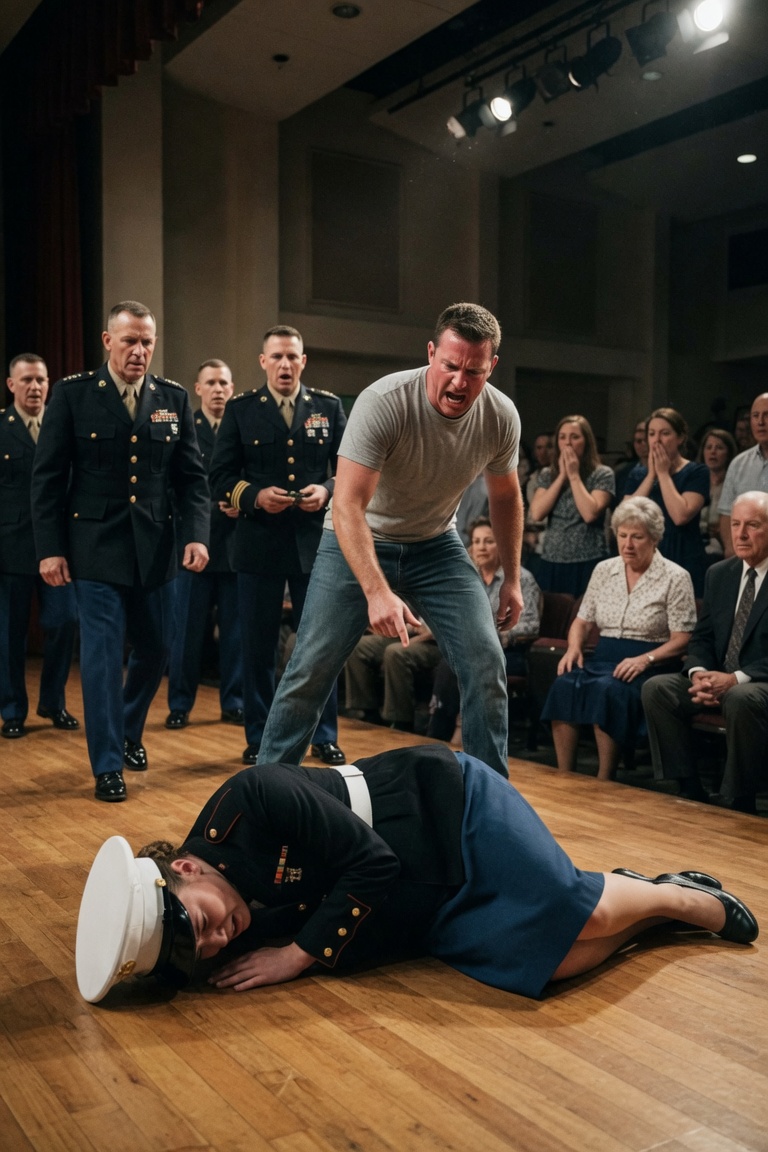
Jacob stepped inside wearing jeans and a gray T-shirt.
He looked exactly like he had sounded on the phone.
Loose, smug, and certain.
He did not pause in the back.
He did not look embarrassed by the rows of uniforms.
He walked straight down the aisle like he had come to collect something that belonged to him.
At first, the room did not understand what it was seeing.
That is how public cruelty works.
People lose half a second deciding whether the impossible thing is really happening.
My commanding officer stopped with the chevrons still in his hand.
A Marine near the aisle shifted forward.
My mother’s head lowered before Jacob even reached the stage.
That was how I knew she understood.
Not because she stood.
Because she looked away.
Jacob climbed the steps.
I remember every sound after that in pieces.
His shoe on the edge of the stage.
The scrape of someone’s chair.
A sharp inhale from the front row.
My own breath catching behind my teeth.
He crossed the floor and hit my pregnant stomach before I could move far enough away.
Pain flashed through me so quickly it became white.
My body folded.
The polished stage met my cheek, cold and hard.
My cover rolled away.
For a moment, I heard the room from underwater.
Voices stretched.
A woman gasped.
Someone said my name, but I could not tell who.
My hand went to my belly because nothing else mattered.
I was not thinking about rank.
I was not thinking about pride.
I was thinking about the tiny life inside me and how unfair it was that a person could be hated before they had taken one breath.
Then Jacob’s voice brought the room back into focus.
“She deserved it,” he shouted.
He said it like a verdict.
Then he added, “She’s a disgrace to this family.”
That sentence had lived in my house for years without always using those exact words.
It had been in Harold’s silence at dinner.
It had been in my mother’s careful eyes.
It had been in Jacob’s smirk whenever he got away with something because making a scene was treated like a bigger sin than causing one.
But the sentence sounded different in that auditorium.
It sounded smaller.
It sounded uglier.
It sounded like what it was.
Nobody rushed to agree with him.
Nobody laughed.
Nobody told me to calm down.
The room went still in a way I had never seen around Jacob before.
My mother stared at the floor.
Harold’s mouth tightened.
Jacob looked around as if he expected someone to help him turn the room back into our house.
That was his mistake.
A base auditorium is not a family kitchen.
A promotion ceremony is not a private hallway.
And Marines do not have to pretend violence is personality.
Boots struck the stage behind me.
General Thorne stepped forward.
I had seen him earlier only from a distance, another authority figure in a room full of authority, but up close his presence changed the air.
He did not rush.
He did not shout first.
He looked at Jacob with a controlled stillness that made Jacob’s bluster seem childish.
My commanding officer moved, too, placing himself between Jacob and the stairs.
General Thorne’s first order was simple.
“Step away from the Marine.”
Jacob blinked.
For my whole life, Jacob had been treated like weather, something everyone endured and cleaned up after.
Now someone had spoken to him like a man responsible for where his hands were.
He tried to argue.
He said we were family.
He said I had always been dramatic.
He said nobody knew what I was really like.
That was when I pushed my phone up from the stage with a hand that would not stop shaking.
General Thorne looked down.
I remember the exact change in his expression when he saw the screen.
Not surprise.
Recognition.
He understood what a recording meant before I could explain it.
“Is that evidence?” he asked.
I nodded.
My throat would not work.
The whole room watched my thumb unlock the phone.
My mother’s purse slid off her lap and hit the floor.
It was such a small sound after what Jacob had done, but it made several people turn because it was the first thing about her that looked unplanned.
Harold reached down for it.
She did not.
She stared at the phone in my hand.
Maybe she was remembering every time she had told me not to make trouble.
Maybe she was afraid of what a room full of witnesses would think of the mother who had trained her daughter to be quiet.
Maybe, for the first time, she could not pretend she had not known.
General Thorne did not ask me to perform my pain for the room.
He only said, “Play it.”
I pressed the screen.
Jacob’s voice filled the auditorium from the little speaker.
At first, it was thin and metallic, the way phone audio always is, but the words were clear.
My uniform did not make me better than anyone.
My Marines were my “jarhead friends.”
He was going to show them what I really was.
A murmur moved through the rows behind us.
Jacob lunged one step forward like he could grab the words out of the air.
The commanding officer blocked him.
Then Harold’s voice came next.
My baby was a problem.
I should cancel the ceremony.
I was going to embarrass the family.
The room did not explode.
That was what frightened Harold most.
Nobody shouted over it.
Nobody gave him the comfort of chaos.
They listened.
Every word landed in a clean public silence.
Jacob started talking fast.
He said I had tricked him.
He said recording family was low.
He said I had set him up because I wanted attention.
General Thorne turned his head just enough to look at him.
“No,” he said. “You spoke. She saved it.”
It was the first time anyone had put the responsibility exactly where it belonged.
Not on the person who remembered.
Not on the person who recorded.
Not on the person who got hurt.
On the person who chose the words and the hands.
A corpsman came onto the stage then, and the shift from ceremony to care happened so quickly I almost broke.
One minute I had been lying there trying not to fall apart.
The next, trained hands were helping me sit up, checking my breathing, asking what hurt, keeping their voices steady because panic would not help me.
I will not pretend I remember every question.
I remember the feeling of someone supporting my shoulders without making me feel weak.
I remember my commanding officer picking up my fallen cover and holding it like it mattered.
I remember seeing the chevrons still in his other hand and thinking the ceremony had become impossible.
General Thorne must have noticed where my eyes went.
He crouched near me, not close enough to crowd me, just close enough that I could hear him without the whole room needing to.
“This moment was yours before he walked in,” he said.
I did not know what to say.
He looked toward my commanding officer, then back at me.
“When you are ready, we finish it the right way.”
Those words did something the recording had not done.
The recording exposed them.
That sentence returned me to myself.
Jacob was moved back from the stage.
I am careful about saying only what I saw, because stories like this grow teeth when people add endings they wish were true.
I saw Marines keep him from coming near me.
I saw officers speak in low voices with the kind of firmness that leaves no space for a tantrum.
I saw Harold stand uselessly beside the front row, red-faced and trapped inside the consequences of his own words.
I saw my mother finally rise, but not in time to be the mother I had needed.
She took one step toward the stage.
Then she stopped.
Her face crumpled, but even then I could not tell if she was hurting for me or for the version of herself the room had just seen.
I wanted that difference not to matter.
It did.
All my life, I had mistaken late tears for love.
That day, I learned timing is part of love.
So is courage.
So is standing up before the damage has witnesses.
The corpsman asked if I could stand with help.
I could, barely.
Every movement pulled fear through my body, but I wanted to be upright for the next part.
Not for pride.
For memory.
I wanted my child, someday, to know that I had not stayed on the floor after someone tried to put me there.
My commanding officer came back with the chevrons.
The room stayed quiet.
No one knew whether to clap.
No one knew whether clapping would feel wrong after what had just happened.
General Thorne solved that, too.
He looked at the room and said, “Attention.”
Every Marine in that auditorium straightened.
Even some of the civilians did.
My mother froze halfway between her seat and the aisle.
Harold stopped moving.
Jacob, held back near the side, had no audience left for his grin.
The commanding officer stepped in front of me.
His voice was steady as he continued the ceremony.
The words sounded different now.
They did not sound like a formality.
They sounded like a line drawn in public.
When the chevrons touched my sleeve, the applause came slowly at first.
Then it grew.
I did not smile the way I had imagined I would when I was younger and dreamed of escaping my family by becoming someone they could not dismiss.
I cried instead.
Not loudly.
Not beautifully.
Just enough that the tears tracked down my face while I kept my hand near my belly and let the room clap for a moment Jacob had tried to steal.
The applause did not fix what had happened.
It did not erase pain.
It did not make my mother brave retroactively.
It did not turn Harold into a man who deserved forgiveness.
But it told the truth in a language my body understood.
You are not alone in this room.
Afterward, I was helped off the stage for care.
My phone was no longer just a phone.
It was the first honest witness my family could not pressure, guilt, or frighten into silence.
My mother tried to speak to me in the hallway.
She said my name softly.
I had waited years to hear tenderness in her voice, and when it finally came, I felt more tired than comforted.
I looked at her and remembered her eyes on the floor.
There are moments when a person tells you who they are not by what they do, but by when they choose not to move.
I did not yell at her.
I did not have the strength.
I only held my phone, my proof, and my stomach, and let other people keep the space around me safe.
That was enough.
Later, people would ask what the worst part was.
They expected me to say the hit.
They expected me to say the pain, or Jacob’s words, or Harold’s voice coming through the speaker.
Those things were terrible.
But the worst part was the second before General Thorne stepped forward, when I looked at my mother and saw her choose the floor again.
The best part came right after.
Not because a general saved me.
Not because a recording embarrassed them.
The best part was realizing that the rules of my childhood did not follow me everywhere.
There are rooms where cruelty is not called temper.
There are people who do not confuse silence with peace.
There are witnesses who understand that proof matters because victims are too often asked to be perfect before they are believed.
I walked into that ceremony hoping my family would finally see me.
I left understanding that being seen by the wrong people is not the same as being loved.
Jacob had thought he could drag our private house rules onto a public stage.
He forgot my phone had recorded him.
He forgot Marines were watching.
Most of all, he forgot that I had been training for months to stand steady under pressure, and that even when my body folded, the truth did not.
That day did not give me the family I wanted.
It gave me something better.
It gave me a line I could build a life behind.
